Showing posts with label John Huston. Show all posts

Wednesday, November 19, 2014

COVER ME #2: TOROS & TORSOS


(Note: Covers can make or break a book. The fact is, we do judge books by their covers. This is the second in a series of posts examining the strategies, concepts and creative process behind the repackaging of the Hector Lassiter series into bestselling, uniform editions for Betimes Books).


"Toros & Torsos" is one of the larger and more ambitious of the Hector Lassiter novels.

It spans four decades and moves from 1935 Key West to 1937, Civil War-era Spain; from 1947 Hollywood to 1959 Cuba, before at last wrapping up in New Mexico, circa 1961. 

The cast includes a mix of fictional and historical characters including Ernest Hemingway, John Dos Passos, Orson Welles, Rita Hayworth, Vincent Price and John Huston.

The novel also concerns itself with recent theories that the murder of Elizabeth Short, the infamous "Black Dahlia," was the work of someone or some people very much preoccupied by the Surrealist art movement.

I took that concept and layered in more crimes and excesses that have been laid at the feet of the surrealists by recent scholarship.

For its original American publication by Bleak House Books, I was able to exert my own vision for the book's packaging. 

I had also had some influence on the final look of "Head Games" for Bleak House. For its sequel, we kept a kind of three-tiered design established for HG.

The Rivera Studio depicted in the painting.

The main image that would front the first American edition of T&T was one found by my agent, Svetlana Pironko, that seemed to embody much of the themes and the sinister/sexy surrealistic feel of the book. Also, for a book so very much about surrealist art, it seemed necessary to have a proper surrealist's illustration front the novel.

The artist is the great Diego Rivera, and the work is called "In the Studio of the Maestro." The Rivera (and Kahlo) works are in the care of the Bank of Mexico, and so, working through various intermediaries and translators, we were able to secure rights for the painting's use.


As the novel moved further out into the world, it got some different packaging. The Korean version incorporates an illustration of a work by Pablo Picasso referenced in the novel.

The French versions of "Toros & Torsos" (retitled "Rhapsody in Black" over there, a confusing development perhaps for readers given that is also the given title of Hector Lassiter's own first-published novel), tended to put women front and center, a consistent theme in the branding of my series in those environs.


When it came time to repackage the novel for Betimes Books' new uniform edition of the Lassiter series, the overall graphic design of the look was pretty well set. The question was one, really, of imagery and color choice.

The image of Beth Short is so associated with James Ellroy's breakthrough novel, "The Black Dahlia," we were resistant to use Miss Short's face too prominently or overtly. (And, frankly, there aren't that many images of Elizabeth Short extant to work with beyond the one adorning the Ellroy novel.)

We tried some very noir concepts like the below, but ulimately abandoned those—they failed, in the end, to put across the artistic subtext that informs the novel.


Next we tried some spins on the infamous crazy house set designed by Orson Welles for "The Lady from Shanghai," a crucial set-piece portion of "Toros & Torsos." (Welles' bizarre set and its severed limbs and torsos would later result in some actually pointing to Orson as a potential, viable suspect in Short's murder, a subplot of T&T.) 
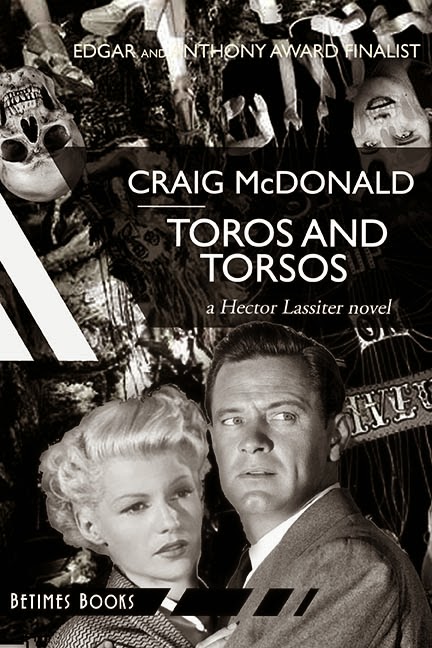


In the end, we choose to focus on the title character and Rita Hayworth, with the most iconic image of Elizabeth Short transformed into a kind of Russian nesting-doll evoking surrealist imagery and some works by Salvador Dali.

Once again, the design and execution of the below is the work of the remarkable J.T. Lindroos, who is giving the Hector Lassiter series its striking, signature look across its span.


At this writing, eight of the ten Lassiter volumes coming from Betimes Books have at last found their definitive covers.

All that remains are a cover for the climactic novel in the series, "Three Chords & The Truth," and a collection of short stories featuring Hector that we'll be calling, "Write from Wrong."

NEXT UP: IT'S ALL "PRETEND"

——————

ONE TRUE SENTENCE: Paperback/eBook

FOREVER'S JUST PRETEND: Paperback/eBook

TOROS & TORSOS: Paperback/eBook

THE GREAT PRETENDER: Paperback/eBook

ROLL THE CREDITS: Paperback/eBook

Wednesday, September 3, 2014

TOROS & TORSOS: SURREALIST ART AND MURDER IN OUR TIME?

Cover image by Dali
for Minotaure Magazine

The first five novels in the Hector Lassiter series—One True Sentence, Forever's Just Pretend and Toros & Torsos—are newly available from Betimes Books. (Ordering information below)


ONE TRUE SENTENCE: Paperback/eBook

FOREVER'S JUST PRETEND: Paperback/eBook

TOROS & TORSOS: Paperback/eBook

THE GREAT PRETENDER: Paperback/eBook

ROLL THE CREDITS: Paperback/eBook
—————————————————————

Art imitates life; death imitates art?

A time back, I put together a post regarding the second novel in the Hector Lassiter series, Toros & Torsos, (now available from Betimes Books) and the fact it spins on the premise that surrealist art and aesthetic theory might have informed or inspired several bloody, unsolved crimes of the 20th Century — most notably the murder of Elizabeth Short, the so-called “Black Dahlia,” as she was dubbed by panting L.A. journalists, circa January 1947.
Statue based on Dali
illustration.

The correspondences between Elizabeth Short’s mutilation murder and photographs and paintings by Man Ray and Salvador Dali were first put forth by Steve Hodel in his 2003 nonfiction study Black Dahlia Avenger, a New York Times notable book and Edgar® Award finalist. (To be fair, James Ellroy had made a particular painting an element of his 1987 novel based on the Dahlia murder.)

Hodel’s theories were greatly expanded upon by Mark Nelson and Sarah Hudson Bayliss in their excellent 2006 release, Exquisite Corpse: Surrealism and the Black Dahlia Murder.
ELIZABETH SHORT

Using the Nelson, Bayliss and Hodel works as a springboard, I extrapolated outward to construct a multi-decade saga that encompasses not only the Dahlia murder and the all-too-real post-war Hollywood surrealist art circle (which included such diverse personalities as John Huston, Fanny Brice and Vincent Price), but also the Spanish Civil War in which the surrealists played a pivotal propaganda role.

Further research in that area uncovered allegations of jaw-dropping reports of Spanish torture chambers designed and constructed to surrealist aesthetics — tantamount to a crazy cross between Escher and Abu Ghraib.

I mixed in some female torsos that began turning up in the vicinity of Ernest Hemingway’s Cuban home in the 1950s…actual mutilation murders touched on by Hemingway in the published version of his posthumous novel, Islands in the Stream.

It takes a strong stomach and a cold eye to confront the evidence put forward in the Hodel and Nelson/Bayliss books — particularly in Exquisite Corpse. But once key surrealist works are compared to Elizabeth Short’s autopsy photos (reproduced in graphic detail in the Nelson/Bayliss books) it’s difficult to shake the notion surrealist imagery was very much on the mind of Betty Short’s twisted, never-apprehended killer.
Man Ray's "Minotaur," meant to evoke the head of a bull.
The upper portion of "The Black Dahlia's" severed body
mimicked this position when found in January 1947.

Life imitating art…art imitating death, and for some twisted type, it seems, it wasn’t truly art until somebody died.

Well, that was then. I posited my killer surrealists operating in the period between 1935-1959—again, it was fiction grounded in apparent fact. Many critics of Toros the first time around thought the concept...fanciful.

A while back, Woody Haut, author of the excellent crime fiction studies Pulp Culture and Neon Noir, among others, very kindly reviewed Toros & Torsos. In passing, he noted, “And don't think surrealist murders are simply the stuff of urban legend. In the part of the world where I'm currently living, near Perpignan, there were a handful of such murders a few years back, the corpses of which supposedly replicated paintings by Dali.”

I followed up on that intriguing aside of Mr. Haut’s. I found an article from The Guardian regarding those Dali-esque crimes… As the author of Toros & Torsos, reading the article was frankly chilling.

As indicated earlier, occasionally, as a novelist you find yourself the subject of these sometimes cutting remarks about the plots of your novels turning on an “outrageous” or “absurd” premise, or you get the left-handed compliment that your novel works despite its “far-out concept” that surrealist art might inspire serial murder.

Yeah, well… Maybe you can’t make this stuff up.

From the March 9, 2000 edition of the Guardian: “Police are wondering if they are not dealing with a serial killer inspired by the tortured visions of Salvador Felipe Jacinto Dali i Domenech, born May 11 1904, died January 23 1989. ‘It's a theory they've tested and are continuing to test,’ says Mohamed Iaouadan, a lawyer. ‘I've seen the files, believe me. They've commissioned analytical reports from art experts on the significance of Dali paintings.’”

As the lawyer quoted in the article goes on to say, “I'm not sure what I think. Maybe it's madness, this Dali stuff. But killers are inspired by films, aren’t they? Why not by decapitations, eviscerations and dismemberments in the painting of the man who made this town famous?”

For more on the contemporary “Dali” case, you can check out the full (and very graphic) account of the crimes in the Guardian here.


ONE TRUE SENTENCE: Paperback/eBook

FOREVER'S JUST PRETEND: Paperback/eBook

TOROS & TORSOS: Paperback/eBook

THE GREAT PRETENDER: Paperback/eBook

ROLL THE CREDITS: Paperback/eBook