Publishers Weekly has weighed in on the first new Hector Lassiter novel in three years. The short-form verdict? PW says: "Entertaining...a must read for series fans and a solid introduction for new readers." Read the entire review HERE.
I had the great privilege of participating in several events during this year's just-concluded 2014 Iowa City Book Festival. Festivities opened Thursday night with a free event in a spooky old church (some time ago "retired" as a house of worship) that focused on James Ellroy and his new novel, PERFIDIA. Mr. Ellroy rapped a bit, then read an excerpt from PERFIDIA. We followed with about 40 minutes of wide-ranging conversation before a packed house. After, we took audience questions and signed our respective works.
I'm told at least one film crew documented the exchange and it will likely appear online soon. In the meantime, here are some bullet points regarding Mr. Ellroy's new novel, the first in his emerging "Second L.A. Quartet." • Mr. Ellroy reread all of the novels in his original L.A. Quartet and subsequent Underworld USA Trilogy in preparation for PERFIDIA, taking detailed notes about his earlier characters that he blended with researcher's notes regarding World War II and war-era Los Angeles.
• He confirmed having an overarching plan for the next three novels in the four-book series, pledging he will deliver "a seamless continuity" across all of the various works.
• As implied by its title, the Second L.A. Quartet (which is technically the first as it's conceived as a prequel) will largely confine itself to Los Angeles. We shouldn't expect to follow any old or new characters to the European or Asian theaters of combat in volumes to come, he said. • Mr. Ellroy did give some hints about volume two of the new series, which he expects to land in about two-and-a-half-years. As foreshadowed in PERFIDIA, we'll be going south of the border for at least a bit of the next book in the company of "lexicon with a brogue" Dudley Liam Smith, whom PERFIDIA indeed indicates is soon-to-be Mexico-bound.
James Ellroy and John Kenyon in the Old Brick.
• The Japanese internments at Manzanar and similar camps are also expected to figure in the new book. For some melodic backstory on that dubious chapter of American history, an older song from Ellroy's fellow Angeleno and contemporary, singer/songwriter Tom Russell, as sung by Tom Paxton:
• Dudley Smith debuted along with his deadly minions Dick Carlisle and Mike Breuning in Ellroy's second novel, CLANDESTINE, also set in the 1950s. Asked if he views that novel fitting into this new, larger conception in any way, Ellroy said he emphatically did not, describing CLANDESTINE as one of his "kid writer" books and a straight-to-paperback effort he views as apart from Smith's other appearances in his mature works and this larger, emerging saga. • Mr. Ellroy is noted for the extensive outlines he uses to create his novels. The outline for PERFIDIA ran to over 700 pages. The U.S. hardcover of the finished book from Knopf also weighs in at 700-plus pages. However, Ellroy noted the original manuscript of PERFIDIA exceeded a thousand pages. • Mr. Ellroy intended to use his mother as an on-the-page character in his new series, but his editor balked, so she's instead hinted at under an altered identity. • Some non-book items: Mr. Ellroy confirmed he is working with filmmaker David Fincher on a potential project based on his eBook original novella "Shakedown," centered on real life (and deceased private eye) Fred Otash. Having said that, Mr. Ellroy made no promises the project would ultimately see the light of day. • He is also working on a script for a new version of the classic film noir "Laura."
——————
On Friday night, a special screening of the Oscar-winning L.A. CONFIDENTIAL was held at FilmScene. While still praising of the work, Mr. Ellroy expressed his opinion the adaptation of his novel is not a "profound" film. It has some significant plot issues, he said, and he isn't convinced by several of the leads. He did, however, praise Guy Pearce and Danny DeVito, as he has done previously.
——————
On Saturday morning, I participated in a discussion with Levi Stahl, editor of a terrific collection of nonfiction pieces by the late-Donald Westlake he calls THE GETAWAY CAR. Mr. Stahl and I briefly discussed our respective works, then read some excerpts (I read from the opening pages of FOREVER'S JUST PRETEND). After, we discussed crime and mystery writers, the craft of crime fiction, and some little known facts about Mr. Westlake, including a youthful criminal act that briefly landed him in jail and may have had an impact on Westlake's later writing career (particularly in terms of subject matter and a potential identification with lawbreakers). Later that same afternoon, I joined Franca Treur, Kinana Issa, June Melby, Chi Li and Jon McGoran for a panel on the twin and tangled topics of "Loyalty and Betrayal."
The very craft of writing was addressed from various perspectives as a kind of potential betrayal by several of us on the panel, although our takes on how the craft of constructing a story—be it "true" or "false"—constitutes betrayal or loyalty reflected significant variation. For my part, I also discussed some of the exterior factors I feel impel today's writers to potentially "betray" their craft in quietly insidious ways—the pervasive demand for constant attention to "platform" and potentially off-putting self-promotion through social media and the like...tasks that threaten to distract from the actual writing. As you may have already gathered, our panel was decidedly multi-cultural (in addition to we three Americans, the other authors represented Syria, the Netherlands and China). It was striking, at least to me, how some of the non-U.S. authors discounted any pressures they felt exerted upon them for similar self-promotional efforts by their publishers or respective cultures. Saturday closed with a "Noir at the Bar" event at FilmScene with fellow crime writers John Kenyon, Jon McGoran and Scott Phillips. We took turns doing some readings. (In a playful gesture, I read a bit from PRINT THE LEGEND, in which perceived genre writer Hector Lassiter finds himself keynoting a literary event and brushing shoulders with sometimes askance literary academics). Following our readings, Scott introduced a screening of THE ICE HARVEST, based on his acclaimed novel of the same name and directed by the late-Harold Ramis.
I want to thank the organizers of this terrific festival and all those great people of Iowa City who turned out for events spread out across the former churches, the coffee shops, senior centers and movie houses of Iowa City.
The first five novels in the Hector Lassiter series—One True Sentence, Forever's Just Pretend and Toros & Torsos—are newly available from Betimes Books. (Ordering information below)
You can make a
good case for Ernest Hemingway having left a profound mark on hardboiled crime
fiction.
Graduate
students and crime fiction aficionados have murdered trees arguing whether
Hemingway influenced Dashiell Hammett or whether inspiration ran the other
direction.
Raymond Chandler
incorporated Hemingway in his fiction, wrote an astonishingly inept parody of
Hemingway prose and staunchly defended Hem’s much-pilloried novel Across the River and Into the Trees.
Hem’s had many near
brushes with composing crime fiction: “The Killers,” that opening Tommy
gun salvo in To Have and Have Not and his aborted crime novel Jimmy Breen (dropped in favor of A Farewell to Arms) — all toed the genre line. Hemingway was in fact a
frequent crime fiction and thriller reader.
In A Moveable Feast, he writes of Gertrude Stein giving him a copy of Lowndes’ Jack the
Ripper novel The Lodger, sending Hem off on a Lowndes reading tear.
Later, he moved on to Simenon, and letters and book requests sent his editor
indicate Hemingway also sampled Chandler, Hammett and Ian Fleming.
In the Cuba
portion of Toros & Torsos, I allude to a woman’s mutilated torso
that was found not far from Hem’s Cuban home, the Finca Vigia. This is not an
invention on my part: the murder is remarked on in several Hemingway
biographies.
Presumably
unsolved, the mutilation murder was variously ascribed to a deranged spouse or
boyfriend, the Cleveland Torso Slayer, some other serial killer or some bizarre
rite associated with a secretive religious cult peculiar to Cuba.
Whatever the truth behind the grisly murder, it clearly made a very
strong impression on Ernest Hemingway as he writes about it in an eerie passage
that survives in his posthumously published novel Islands in the Stream.
I haven't done much road work bookwise, of late—not since a gig in Quebec a while back with Larry Block, Daniel Woodrell, Ian Rankin and some others. But Thursday through Saturday night I'll be in Iowa City for the Iowa City Book Festival, just in time for the Betimes Books release of the Hector Lassiter series in its entirety for the first time. (One True Sentence, Forever's Just Pretend, Toros & Torsos, The Great Pretender and Roll the Credits—three of those titles brand new—are now available in a matched set of snazzy looking trade paperbacks, complete with new introductions and reader discussion group questions. Five more titles, new and old, are coming soon). If you're in the Iowa City area later this week, or already planning to make the scene, I'll be participating in four events. Please drop by and say hello, or catch me at the various venues: I'd love to rap with you about books, writing and, generally, all things literary.
Thursday, Oct. 2, 2014
7:30 p.m.
James Ellroy interview and reading
Old BrickJames Ellroy
in conversation with Craig
McDonald, at Old Brick.
Ellroy, the self-proclaimed “Demon Dog of American Crime Fiction,” will read
from and discuss his new novel, Perfidia, with fellow novelist McDonald.
McDonald has interviewed Ellroy in the past, most notably for his interview
collections, Art in the Blood and Rogue Males. Free and open to
the public. Individuals with disabilities are encouraged to attend all Iowa
City Book Festival events. If you need an accommodation in order to participate
in this program, please contact our office at info@cityofliteratureusa.org or
319-887-6100.
Levi Stahl
(editor of the new Donald Westlake non-fiction miscellany, The Getaway Car)
and Craig
McDonald (Forever’s Just Pretend) read from and discuss their
new books.
2:30 p.m.
Panel: Loyalty and Betrayal
Iowa City Senior Center Milan Kundera has asserted that ‘the first betrayal is irreparable.
It calls forth a chain reaction of further betrayals, each of which takes us
farther and farther away from the point of our original betrayal.’ Loyalties
grow out of biology, place of origin, upbringing, affections, nationality,
etc.—writers discuss their own loyalties, those that they adhere to and those
they betray. Featuring Kinana Issa, Chi Li, Craig McDonald, June Melby, and
Franca Treur.
9 p.m. Noir
at the Bar
Join us
for a free late-night gathering of crime fiction authors reading
from their work, talking shop and enjoying drinks with the
audience. This special Iowa City Book Festival edition of Noir at the
Bar will feature authors:
Scott
Phillips - (Hop Alley, 2014;Cottonwood,
2004; The Ice Harvest, 2000)
Jon McGoran - (Deadout: A Thriller, 2014;Drift, 2013)
Craig
McDonald - (Forever's Just Pretend, 2014; El
Gavilan, 2011; Head Games, 2007)
John Kenyon - (Get Hit, Hit Back: A Fight Card Story, 2013; The First
Cut, 2012)
Following
the reading, Phillips will introduce a free screening of THE ICE
HARVEST, adapted from his novel of the same name and directed
by Harold Ramis.
Roll the Credits is, in short form, the Second World War and liberation of Paris seen through the eyes of author/screenwriter Hector Lassiter. But it's also a special novel in the Lassiter canon for me. Long before RTC, there was the Lassiter entry Head Games. That novel was dedicated to the memory of my maternal grandfather, William Charles Sipe, Sr.
In Head Games, I was trying to write the kind of fiction book my grandfather most loved to read—pulpy and fast, but with some gritty (and dark) heart.
My granddad had three sons, two of whom would serve in the military.
William C. Sipe Sr. and Jr.
The eldest, whose shared name promoted by grandfather to "Sr." status, saw action in Europe during the Second World War. He passed away a few years ago. One night, bumping around online, I found a little photo of Uncle Junior in Europe, in what appear to be happier times. This is the shot:
In a bar in Corvallis just before the 70th went to Fort Leonard Wood. From left to right: J.D. Hollingsworth, William C. Sipe Jr, Johnny Borowski and Johnny Kaufman.
He's the dark-haired guy in the dark jacket. I've spent a lot of time looking at that photo. I see some of my own features in that face...imagine how different my life was at that age from his.
Once—just once—I remember my grandfather talking about some war experiences shared with him by my Uncle Junior. It was graphic, pretty terrible to hear, even for a nine- or ten-year-old with already dark reading tastes. At the time, I thought maybe my grandfather was reciting this story from conversational memory.
Many years later, some of my grandparents' photos and letters were passed down to me. Among them, I found a letter my uncle had written his parents from over there. Its written in cursive, in pencil. I saw then that the one-off, dark story my grandfather shared with me sprang from this letter. Some excerpts:
May 28, 1945 Hanau, Germany Dear Mother: This is Monday. I'm ok, everything is allright here. I haven't received a letter from you for three days now. I hope this finds you all well. Tell the children hello from me. They have relaxed the censorship regulations so now I can write more than I could before. There's a lot that I would like to tell you but it would take a whole tablet. I can tell you the town that I have been in and the ones we have fought in. I'm glad that at the time I was in combat I couldn't tell you much because I would have worried you more than before. When we left Fort Leonard Wood, we went to Camp Miles Standish near Boston. We were there from the 23 of Dec to the 8th of Jan. We reached port after nine days at sea. It was Marseille in Southern France. The harbor there was filled with sunken ships. The first night there we had an air raid it really gave us a thrill but it was nothing like the things that were to come. In about two weeks, we started to the front to go into combat. We were all on edge not knowing what was to come. In about a week we had reached a position about two miles behind the front lines. We couldn't sleep at night because the big guns were firing continuous. We were shoved into combat in about three more days. We started fighting in France... I want to tell you what my job was before I go any further. I'm in a liaison section it works with the infantry. We live, sleep and eat with them on the front lines. We direct the artillery fire on the enemy, therefore we have to be on some high ground where we can see our troops and the enemy at the same time. The most that I have ever been scared was one night when we were on Spicheren Heights, near Spicheren France. We were on the very front lines... We were sitting on top of this hill overlooking the Krauts. All at once they started a drive and we were caught flat-footed. They sent about 20 tiger tanks at us and about 300 men. I was never so scared in my life. I was in a foxhill on top of a hill and didn't have a chance in the world of getting out. You have never seen or could imagine a sight like it. The shells were hitting the ground and the trees all around me. The tanks were about 300 yards from us and our anti tank guns were doing a pretty good job on the tanks but the Krauts kept on coming. The tanks came to about 100 yards of us and stopped, but the infantry kept right on coming. We were directing fire from the artillery on them and killing a lot but more kept coming. When they got too close for artillery fire all I could do was fight side by side with the infantry. They were within fifty feet of us before we opened up with our small arms. They were dropping like flies but so were our men. Three of them came for the same foxhole I was in, shooting their rifles at me. I knew that I had to do something quick so I stick my head (out) and let go about 50 shots from my Tommy gun at them. Most of my shots hit them in the stomach and they died instantly. They were the first that I've ever killed and were the last. By that time our tanks had gotten up there and more infantry. We pushed them back to where they were before and the next day we drove on... Sometimes I dreamed about those three men I killed. They were about 22 or 23. I will close now. Write and don't worry. I'm in no danger now and I won't be unless I should go to Japan. Love, Bill
————
Update: I've since found a long, compelling, photo rich history of the 493rd Amored Field units' combat history that lays out the action that so affected my uncle. (P. 41 of this pdf.) It appears it happened on Feb. 22, 1945: "They closed in on our troops from four sides. The attack was sustained for 30 minutes..."—CM
————
When I was a kid, World War II wasn't all that long ago. Most of its surviving vets were still fairly vital men. This year they are in astonishingly short supply.
We particularly romanticize that conflict, of course. So many great love songs came out of it; they still grind out WWII movies.
To many minds, rightly or wrongly, that war constitutes the last just and "good" war.
In the course of writing Head Games, I included an article penned by poet Bud Fiske about Hector Lassiter's life—some pulpy bio/profile Fiske had penned for the long-defunct men's journal, True Magazine.
I built into Hector's backstory a kind of notorious World War II history lifted from the life of author Ernest Hemingway.
In effect, Hem went over to Europe as a war correspondent, but morphed into a guerilla leader who was among the first into Paris, precisely seven decades ago this year.
In writing Print the Legend, I again injected a little more about Hector and his picaresque, somewhat controversial World War II war correspondent comportment.
Flash forward a year or so. All of the original projected seven novels in the Hector Lassiter series were in at least first-draft form. Head Games was then freshly nominated for an Edgar Award for Best First Novel. Hector and I had some buzz.
An editor from St. Martins comes courting. John Schoenfelder reads all of the Lassiter drafts. We have this long evening telephone conversation in which he pitches me on writing yet another Lassiter. Its the Lassiter he really wants to publish, but doesn't yet exist. The novel John envisions would encompass Hector's World War II adventures. (He had some other ideas, too, some involving Hector and the writing of Mein Kampf, a concept I could just never figure out a way to bring off...)
I went down some different alleys when I began to tackle that book.
I wanted to touch on pre-WWII German cinema's influence on film noir, the genre sometimes-screenwriter Hector Lassiter swam so deeply in. My now sixteen-year-old eldest daughter was deeply engrossed by the Holocaust and Anne Frank at the time. More grist...
I was also reading some newly released materials related to Hemingway's WWII efforts, along with some books about the OSS and this strange special military ops branch...
Seems at some point, the Office of Strategic Services employed filmmakers, authors and other creative types to engage in black-ops and efforts at enemy misdirection. These guys recorded soundtracks to emit from empty forests that simulated nonexistent troop action. They painted canvases to fox aerial surveillance planes into "seeing" rows of planes and tanks.
They used authors like Hector to script fake radio chatter studded with bogus intelligence disguised as injudicious, informal banter.
All of this went into the stew, along with Mr. Schoenfelder's insistence that the whole brew come to a boiling point with a climax in what he termed, "the steaming jungles of Brazil."
There was so much to get into the pot—the turbulence of the Liberation of Paris, the reprisals against those Parisians who collaborated or consorted with the occupying German forces... The fallout for the Hemingways and Lassiters who bent the rules to help the great cause...
But then Roll the Credits went onto the back burner for a long time. John and I edited Credits, had it in line for a 2011 release, but then John moved on to other publishing fields and I sensed his successor wasn't fully behind RTC, didn't connect with the novel's subject matter.
I instead pitched her on a swap, and we ended up with One True Sentence closing out my St. Martin's contract run. (I did creep the antagonist from RTC into the opening pages of OTS, however.)
In the intervening years, verbal agreements were made to publish RTC elsewhere, and then they dissolved. Things fell apart; the center would not hold.
Enter Betimes Books: At last, on the 70th anniversary of the Liberation of Paris, Roll the Credits finally sees the light.
This is Hector's own private war from Lyon through Paris and on into the Liberation. From there it's back into Hollywood, just a few months after the events of Head Games.
And, for John, it's those steaming jungles of Brazil in all their sweaty, deadly glory.
Roll the Credits marks the first time since Head Games that Hector narrates his own story. RTC is also the last of the big-page-count Lassiter novels. (You need some real room for a subject as big as WWII and the birth of film noir).
This one was written in the early months of 2009. Like Toros & Torsos, it came together very quickly in first draft.
The greater struggle was finding the right title for the book. For the longest time, the novel lived under the pulpy working title, Hector Lassiter vs. the Nazis. In the end, I took inspiration from the title of a then recently-released song by Tom Russell that went to the heart of RTC's cinematic themes. Here's a music video of that tune, as well as the three book trailers prepared for Roll the Credits.
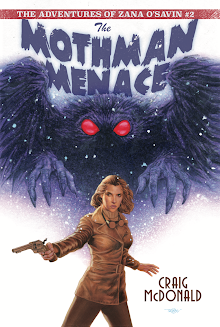
The Adventures of Zana O'Savin continue! Pulp fiction for our time in the spirit of Doc Savage, The Shadow & The Avenger.
THE BLOOD OGRE
Prolific pulp novel legends Lester Dent (Doc Savage) & Walter B. Gibson (The Shadow) both had the actual experience of witnessing their characters come to life, a chilling historical claim that sets the stage for this new series of neo-noir pulp adventures!
WRITE FROM WRONG
Hector Lassiter, Black Mask Magazine legend, crime novelist and screenwriter rubs shoulders with a who's who of 20th Century legends including Ernest Hemingway, Doc Savage creator Lester Dent, Walter B. Gibson of Shadow fame and Orson Wells.
HEAD GAMES, THE GRAPHIC NOVEL
A pulp-noir adaptation of the Edgar Award-nominated novel introducing Black Mask author, crime novelist and screenwriter Hector Lassiter.
Edgar®/Anthony/Macavity/Gumshoe/Crimespree nominated novelist of HEAD GAMES: THE GRAPHIC NOVEL, ONCE A WORLD, WRITE FROM WRONG, ONE TRUE SENTENCE, FOREVER'S JUST PRETEND, TOROS & TORSOS, THE GREAT PRETENDER, ROLL THE CREDITS, THE RUNNING KIND, HEAD GAMES, PRINT THE LEGEND, DEATH IN THE FACE, THREE CHORDS & THE TRUTH, EL GAVILAN, PARTS UNKNOWN, CARNIVAL NOIR, CABAL and ANGELS OF DARKNESS. Nonfiction titles include ART IN THE BLOOD and ROGUE MALES: CONVERSATIONS & CONFRONTATIONS ABOUT THE WRITING LIFE.
ONCE A WORLD — The acclaimed prequel to the Hector Lassiter series
Hector Lassiter's story begins, from his journey into Mexico to catch Pancho Villa, to the bloody trenches of World War I.
ONE TRUE SENTENCE (Hector Lassiter Series #1)
Hector Lassiter Series: #1 Bestseller, Amazon.com.au; One Of BookPeople's Top 10 Of 2011 & Poisoned Pen Staff Favorite. "Vivid, remarkable characters... Absolutely gripping!"—Diana Gabaldon
FOREVER'S JUST PRETEND (HECTOR LASSITER SERIES #2)
Hector Lassiter Series: #3 Bestseller, Amazon.com.au! "Entertaining...a must read for series fans &...for new readers."—Publishers Weekly
TOROS & TORSOS (HECTOR LASSITER SERIES #3)
Hector Lassiter Series: #4 Bestseller, Amazon.com.au! Named to numerous Year's Best Lists! "A bold, ambitious, genre-bending novel."—George Pelecanos
THE GREAT PRETENDER (HECTOR LASSITER SERIES #4)
Hector Lassiter Series: #2 Bestseller, Amazon.com.au! "McDonald cagily splits up the action, with Welles in full enfant terrible mode in the first half of the book—much of the story unfolds on the night of the infamous War of the Worlds broadcast in 1938—while the second takes place in the late 1940s as the filmmaker's star is already burning out."—Vince Keenan, author of DOWN THE HATCH
ROLL THE CREDITS (HECTOR LASSITER SERIES #5)
Hector Lassiter Series: #5 Bestseller, Amazon.com.au! "A writer of truly unique voice, approach, and ambition, Craig McDonald delivers again with ROLL THE CREDITS. Not to be missed." —Michael Koryta
THE RUNNING KIND (HECTOR LASSITER SERIES #6)
"Just the right amount of history, suspense, action and familiar faces to make his alternative history fascinating."—Terry Bowman, author of FIONA'S RULES
HEAD GAMES (HECTOR LASSITER SERIES #7)
Hector Lassiter series: Edgar & Anthony Awards Finalist! #5 Bestseller, Amazon.com.au! Coming autumn 2017 as a graphic novel from First Second! "Smart, it's funny, and it moves like a roach when the lights go on."—James Sallis
PRINT THE LEGEND (HECTOR LASSITER SERIES #8)
Named To More Than A Dozen Year's Best Lists; the most translated of the internationally best-selling series of novels! "An epic masterpiece.”—Michael Connelly.
DEATH IN THE FACE (HECTOR LASSITER SERIES #9)
The penultimate Hector Lassiter novel with 007-creator Ian Fleming; selected by The Rap Sheet as a 2015 novel of the year; praised by Publishers Weekly and Booklist!
THREE CHORDS & THE TRUTH (Hector Lassiter series #10)
The climax of the Hector Lassiter series, from Betimes Books. "With THREE CHORDS & THE TRUTH, Craig McDonald has crafted a remarkable coda to the series."—Steven Powell, author of JAMES ELLROY: DEMON DOG OF CRIME FICTION; "Grabs the reader by the throat." —Publishers Weekly. Get your copy here https://www.amazon.com/dp/B01N0D4UFX
BORDERLAND NOIR
Now Available from Betimes Books
EL GAVILAN
Starred Review From Publishers Weekly! PW Pick of the Week. "As sobering and as urgent as tomorrow's headlines."—Publishers Weekly
PARTS UNKNOWN (CHRIS LYON SERIES #1)
#1 in Chris Lyon series of eBook exclusive thrillers, now available
CARNIVAL NOIR (CHRIS LYON SERIES #2)
#2 in Chris Lyon series of eBook exclusive thrillers, now available.
CABAL (CHRIS LYON SERIES #3)
#3 in Chris Lyon series of eBook exclusive thrillers, now available.
ANGELS OF DARKNESS (CHRIS LYON SERIES #4)
#4 in Chris Lyon series of eBook exclusive thrillers, now available and featuring Hector Lassiter!


 Mr. Stahl and I briefly discussed our respective works, then read some excerpts (I read from the opening pages of FOREVER'S JUST PRETEND).




 Posts
Posts


