Showing posts with label J. Edgar Hoover. Show all posts

Wednesday, November 1, 2017

HEAD GAMES THE GRAPHIC NOVEL "REAL CHARACTERS" #9: RODOLO FIERRO

The Hector Lassiter novels (ten of them, including HEAD GAMES) frequently incorporate real people.

All of that carries over into HEAD GAMES, THE GRAPHIC NOVEL, now available from First Second Books.

ORDER HEAD GAMES: THE GRAPHIC NOVEL

Any hero can best be measured by the degree of threat posed by his arch antagonist.

Or so pop-lit theory goes.

The thing with HEAD GAMES THE GRAPHIC NOVEL, is there there’s a whole hellish host of potential candidates for the role of Hector Lassiter’s central foe, from Yale Skulls & Bones frat brothers, to FBI and CIA spooks, to J. Edgar Hoover, to a certain political dynasty of just-last-week freshly compromised stripes with the surname of “Bush.”

And, there is this OTHER ghost known variously as “El Carnicero,” or “The Butcher,” or by his given name, Rodolfo Fierro.
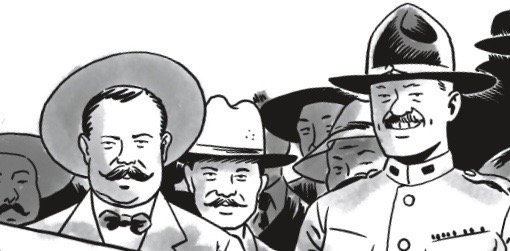
In this shot taken of Pancho Villa and General John
"Black Jack" Pershing
together sometime before Pershing would lead
the hunt for Villa, Fierro smiles over Villa's left shoulder.
That same moment as portrayed in
HEAD GAMES THE GRAPHIC NOVEL
(First Second Books)

Rudy was the bloody right arm of Mexican revolutionary Francisco “Pancho” Villa. Fierro’s viciousness and inventive ways for killing are the stuff of darkly-enduring legend.

Across a series of recent blog entries, I’ve been profiling the “real characters”—in other words, the very real historical figures—who populate HEAD GAMES THE GRAPHIC NOVEL.

I see no value in reinventing the wheel when it comes to profiling Fierro, AKA, “The Butcher” here.
In this case, I defer to a very fine take on Fierro penned by my brother-in-arms and BORDERLAND NOIR collaborator and fellow journalist (and distinguished historian), Jim Cornelius, as offered up at his very fine blog Frontier Partisans.

Spoiler(?) caution: You’re going to see a certain photo there that might seem to undermine the plot of my novel-turned-graphic novel.
Fierro's alleged end as depicted in HEAD GAMES
THE GRAPHI NOVEL.
I submit this for your cynical consideration: Look around the web, and you can find a similar Kremlin-released photo of a supposedly dead Sydney Reilly (the British intelligence inspiration for James Bond by Ian Fleming’s admission) who some believe (and for which there is some evidence) may have lived well beyond his alleged death in the early 1920s from a shot to the back by a Soviet sniper.

Given the state of the early 20th Century photography, I’ll only submit it doesn’t take much talent at all to lay there stock still for a few seconds of bad shutterbug practice…

To play dead for a grainy photo is particularly easy when one is allegedly dripping in gold bullion to pay off presumed gawker/mourners before moving on to your sweet new anonymous life.

Just saying…

An elderly Butcher contemplates his former chief's skull
in HEAD GAMES THE GRAPHIC NOVEL.

Read more about Fierro from Jim HERE.


Charles Bronson portrayed Fierro in a 1968 film "Villa Rides". In the clip following, Bronson depicts a notorious Fierro moment of blood-thirsty mass murder, also acknowledged in HEAD GAMES THE GRAPHIC NOVEL. (A little Easter Egg for you: The character portrayed by Robert Mitchum, a pilot, you'll see in there also makes a cameo in my Hector Lassiter novel, THE RUNNING KIND):


THE HECTOR LASSITER SERIES, AS PUBLISHED BY BETIMES BOOKS:

#1 ONE TRUE SENTENCE: Paperback/eBook

#2 FOREVER'S JUST PRETEND: Paperback/eBook

#3 TOROS & TORSOS: Paperback/eBook

#4 THE GREAT PRETENDER: Paperback/eBook

#5 ROLL THE CREDITS: Paperback/eBook

#6 THE RUNNING KIND: Paperback/eBook

#7 HEAD GAMES: Paperback/eBook

#8 PRINT THE LEGEND: Paperback/eBook/audio

#9 DEATH IN THE FACE: Paperback/eBook

Tuesday, June 9, 2015

SECRET HISTORY: THE DEATH OF ERNEST HEMINGWAY


PRINT THE LEGEND, my Hector Lassiter literary thriller about the death of Ernest Hemingway and FBI Director J. Edgar Hoover's war on American authors, is now available for the first time in paperback, as well as eBook/audio formats. 

The following is an essay written in 2010 for the hardcover edition's release that originally appeared in Mystery Scene Magazine.

__________________


Ernest Hemingway wrote, "All stories, if continued far enough, end in death." It's possible Hemingway's 1961 death by shotgun blast was something other than the suicide history records.

My new novel, Print the Legend, explores Hemingway’s demise: one of the most infamous of American authors’ deaths. Given its violent circumstances, it may also be the most unjustly under-investigated.

If Papa’s fourth wife, Mary Welsh, had actually set out to cast suspicion upon herself in relation to her famous husband’s death, she could hardly have done a better job.

When Ernest’s apparent self-destructive impulses first manifested themselves, Mary took some efforts to protect Hemingway from himself.

But on his first night back from his last round of electroshock treatments administered at the Mayo Clinic — shock treatments approved by Mary for a man who had sustained innumerable concussions and therefore was not a prospect for such radical treatment — Mary reversed course. 

Mary locked away her husband’s extensive cache of guns. But she left the key to their hiding place on a shelf above the kitchen sink. She left them there in plain sight the night of July 1, 1961 — the eve of her widowhood.

When confronted about virtually handing her husband the means to kill himself, Mary argued nobody had a right to deprive a man “his possessions.”

Papa’s last wife was alone with her husband in their Ketchum, Idaho home that bloody morning.


By her own account, Mary didn’t immediately respond to the sound of the twin shotgun blasts — despite the fact the fatal shots were fired directly under her bedroom.

She had vaguely heard, she said, what sounded like “drawers slamming shut.” She claimed to find the carnage later in the morning.

Within a few hours of Ernest’s death, Mary was working the phones — calling friends and family…syndicated columnists. She was engaging in deft spin-doctoring decades before the term was invented.

One of those who received one of the strange, morning-of calls from the newly minted widow was Hemingway friend, William Walton. Many years after that bloody July morning, when confronted by scholar Rose Marie Burwell’s suspicion that Mary wanted her husband dead, Walton confided, “Now that you’ve said it, I will say what I have never said before, but have known since Mary called a few hours after Ernest’s death: yes, she did.”

Mary claimed Papa’s death was a gun-cleaning accident. The physician of record advanced that story, though he also noted there was no evidence of gun-cleaning materials found at the death scene.

The widow Hemingway was also an active participant in an ad hoc committee to determine whether there should be an inquest. Mary carried the day — no official inquiry was made.

Family cleaned up the death scene; the shotgun was destroyed — either by a family friend, or the Hemingway sons — accounts vary.

In the wake of Ernest’s death, Mary became Papa’s literary executrix — revising his manuscripts, re-titling his books…designing his dust jackets and reaping huge financial rewards.

Did Mary murder Hemingway?

Could, perhaps, she have played some other role in his passing?

In Print the Legend, I supply my own theory regarding Hemingway’s death — something other than the one that history records.


ONE TRUE SENTENCE: Paperback/eBook

FOREVER'S JUST PRETEND: Paperback/eBook

TOROS & TORSOS: Paperback/eBook

THE GREAT PRETENDER: Paperback/eBook

ROLL THE CREDITS: Paperback/eBook

THE RUNNING KIND: Paperback/eBook

HEAD GAMES: Paperback/eBook

PRINT THE LEGEND: Paperback/eBook/audio