Nazis, black magic and secret history collide in Craig McDonald's "The Great Pretender," which spans the decades-long, uneasy friendship between Hector Lassiter and Orson Welles, from the run-up to Welles’ infamous War of the World’s “Panic Broadcast of 1938” to the set of the noir classic "The Third Man" and ruins of post-war Vienna. The novel finds the actor and author in a race for a lost holy relic promising its possessor infinite power but a ghastly death if lost. Hector and Orson's competitors in their quest for the "Spear of Destiny" or "Holy Lance" include German occultists, members of the Third Reich, a sensuous Creole Voodoo priestess and a strangely obsessed J. Edgar Hoover. —Jacket copy for THE GREAT PRETENDER, The Fourth Novel in the Hector Lassiter series.
Readers of the Hector Lassiter series who kept up with various interviews I gave over the years may have rightly been taken by surprise by the announcement and release of THE GREAT PRETENDER in Autumn 2014. When Betimes Books determined to publish the entire Hector Lassiter cycle, and in something like chronological order, it spurred me to write two additional novels I’d originally contemplated, and even taken cracks at here or there, but hadn’t quite pulled together when the original eight novels were completed between roughly 2006 and 2010. THE GREAT PRETENDER and DEATH IN THE FACE, featuring respectively, Orson Welles and Ian Fleming, were key to telling Hector’s larger arc as writer and man over the course of the series of novels. They were also the last of the Lassiter novels I wrote in what became a finite, 10-novel cycle. Both were written after a hiatus of a few years of writing about Mr. Lassiter. The supernatural plays a significant role in THE GREAT PRETENDER: I’d long planned to write something involving Hector and voodoo, maybe set largely in the 1940s and spread over perhaps the French Quarter and Harlem. But I just couldn’t quite find the hook to hang it all on, until, when preparing the novels for a brisk, Betimes’ publication, I decided Orson Welles required a “Print the Legend”-style treatment that would bring the auteur front-and-center after memorable, extended cameos in HEAD GAMES and TOROS & TORSOS.
PRINT THE LEGEND is my magnum opus on recurring Lassiter “character” Ernest Hemingway; I felt Orson needed a similar deep-dive narrative to fully illustrate his cautionary example, again, ala Hemingway and later, Ian Fleming, for an aging Mr. Lassiter. It was at that point that I dusted off some go-nowhere drafts of my Lassiter voodoo novel and began to reimagine the tale through a Wellesian prism. Orson was a very dedicated, and high-end "amateur" magician, as I’d already touched upon in T&T. He was also a bit of an occultist and a key figure in early-20th Century race relations and its intersection with art, most notably in his all-Black production of Macbeth (popularly referred to as “Voodoo Macbeth” in the day).
Also, as earlier touched upon in TOROS & TORSOS, Welles had dared to pursue an interracial love affair with torch singer Billie Holiday around the time he was shaping CITIZEN KANE. With Welles firmly in place as Hector’s main foil, and the plot beginning to take shape as it zig-zagged around and through Welles’ heyday successes to his quick-arriving eclipse as a bankable director, more of the plot began to suggest itself. The novel’s late-1930s setting and use of the Panic Broadcast—an event widely regarded as having been fueled by European war flames that would soon reach America—suggested a Nazi subplot that would transition the series into the next Lassiter book, the World War II-centric ROLL THE CREDITS.
At first glance, Nazis and the occult might not seem like much of a thing outside of a couple of Indiana Jones films. But George Lucas certainly didn’t invent Nazi fervor for the occult. Decades before Indiana Jones stole Doc Savage’s act and chased after the Ark of the Covenant, The Thule Society, a loosely described “German study group" that cherished all things “Aryan” also embraced “esoteric studies” and “lost” relics collection.
The Thule Society also required recruits to sign an oath assuring, “"The signer hereby swears to the best of his knowledge and belief that no Jewish or coloured blood flows in either his or in his wife's veins, and that among their ancestors are no members of the coloured races." Not so surprisingly, the Thule Society became a foundational organization for the eventual Nazi party. While Adolph Hitler might not have been much of an occultist himself, several of his key henchman emphatically did embrace the supernatural. Orson Welles. Nazis. The occult. These are the spooky engines propelling THE GREAT PRETENDER. You can read the first chapter here. (Mr. Welles will also be a strong presence in the forthcoming, HEAD GAMES: THE GRAPHIC NOVEL, coming Oct. 21 from First Second Books.)
"With each of his Hector Lassiter novels, Craig McDonald has stretched his canvas wider and unfurled tales of increasingly greater resonance." --Megan Abbott
"Reading a Hector Lassiter novel is like having a great uncle pull you aside, pour you a tumbler of rye, and tell you a story about how the 20th century 'really' went down." --Duane Swierczynski
Nazis, black magic and secret history collide in Craig McDonald's "The Great Pretender." In 2007, McDonald launched the Hector Lassiter series with the Edgar Award-nominated debut, "Head Games," pairing the globetrotting, larger-than-life crime novelist with equally legendary filmmaker and amateur magician Orson Welles. "The Great Pretender" fits the capstone on the Lassiter/Welles legend, spanning their decades-long, uneasy association from the run-up to Welles' infamous "War of the Worlds Panic Broadcast of 1938" to the set of the noir classic "The Third Man" and the ruins of post-war Vienna. The novel finds the actor and author in a race for a lost holy relic promising its possessor infinite power but a ghastly death if lost. Hector and Orson's competitors in their quest for the 'Spear of Destiny' or 'Holy Lance' include German occultists, members of the Third Reich, a sensuous Creole Voodoo priestess and a strangely obsessed J. Edgar Hoover.
____
Sample chapter (Spoiler caution: Don't read the following if you have not already read "Forever's Just Pretend"!):
1
THE STRANGER
“Perception is reality, that’s how the saying goes, isn’t it, Hec?”
Hector Lassiter, novelist, screenwriter, and for the moment, literary executor, looked down at all the chilly pedestrians scurrying through the autumn wind tearing along Fifth Avenue. The fierce wind made eyes water and noses run down there. Up here the wind cut to bone. He called above its roar, “That’s indeed what some say, Mathis.” Hector lit a cigarette with his windproof Zippo, engraved with the legend, “One True Sentence.” He slipped the lighter into the pocket of his overcoat.
Standing on the eighty-sixth floor of the world’s tallest and most famous building, Hector pulled on his right glove and took another hit from the coffin nail as he stared up at the dirigible mooring mast—a pointless novelty—looming higher above them.
Hector wasn’t crazy about heights and the view up made his legs tremble. Taking a deep, icy breadth, he looked back down the side of the Empire State and said, “Suppose as clichés go, that one is true enough. Least so far as it runs. Take those people down there. They only look like ants, you know.”
They were supposed to be having this meeting over coffee in a cozy place downstairs. But Hector had talked his companion into coming up here in the wicked wind where only fools, would-be suicides or stubborn tourists would venture on a blustery, late autumn day. Hector had his reasons.
Peter Mathis, rising New York publisher, smiled and said, “Sure. Anyway, this is a remarkable turn to say the least. Imagine, the popular and mysterious mystery writer, Connor Templeton, and the cult crime author, Bud Grant, being one-in-the-same. But, no, that’s not enough! Both of those male writers were actually the pen name for a raven-haired stunner named Brinke Devlin! My publicity people are going to go berserk in the best sense with this, Hec. It transcends the merely remarkable. And it’s surely money in the bank. Having seen some snapshots of Brinke, this wife of yours who wrote like a tough, lusty he-man and yet looked like a far prettier, bustier Louise Brooks? All I can say is, this will be huge.”
“Money isn’t the point, not for me,” Hector said. “And certainly not for her. Publication, long-term, hell, permanent publication, is the aim. This is about her legacy. This is about Brinke’s long game. Literary immortality is the objective.”
“Well, of course,” Mathis said. “That’s one of the things you pay me for, isn’t it?”
Hector nodded. “Just making sure we’re clear on my primary goal in signing with you to at last publish all of her books under Brinke’s real name.” It was a Hail Mary gambit on Hector’s part. His first wife’s literary oeuvre under both her pen names had lately gone out of print. Hector simply couldn’t stomach that. Brinke could never slip into literary obscurity, not so long as Hector lived.
The two men shook gloved hands. Mathis said, “To my last comment, I’m in danger of being late for a meeting about some of Thomas Wolfe’s posthumous works. We’re in negotiations about trying to do something more significant with 'O Lost'. I still can’t believe he’s dead. And gone so young. Did you ever meet Tom?”
The North Carolina novelist and Ernest Hemingway’s bête noire had died last month. Tom’s was a sudden and bad death, like Brinke’s, only of natural causes. Hector let go of the man’s hand. “Crossed paths two or three times, I suppose. Seemed a nice enough fella in the moment. A decent, if undisciplined, fiction writer. He drove Hem to distraction, I know. Anyway, thirty-seven is far too young to be dead, regardless of what you did or how well you maybe did it.”
“Indeed. Well, at least Tom didn’t have to suffer too long. There’s real comfort in that, yes?”
“Sure there is.”
They said their goodbyes. Hector watched the publisher go, then checked his watch. His next appointment was characteristically late. He turned up the collar of his overcoat and thrust his hands deeper into its pockets, looking out across the city but also watching the other lone man standing a bit off to Hector’s left, the author’s presumed stalker—his reason for dragging the publisher and the actor yet to come up here in the roaring, cold wind.
But there’d be time for that later, if indeed the man was really following the writer. For now, for better or worse, Hector’s head was elsewhere. Dead at thirty-seven? Jesus Christ, didn’t that resonate? Come January, Hector would be thirty-nine. Brinke would have been, what? Forty-three, forty-four? Something like that. Hector damned himself for not being certain. Either way, his first and truest love had never seen 1926.
That voice—it rose above the roar of the wind. “Hector, old man! Don’t you look well?” It was l’enfant terrible himself, George Orson Welles, twenty-three, red-cheeked and already the toast of the Great White Way and the radio airwaves. Orson, still tragically baby-faced, was sporting the sparse shadow of a beard he was growing for a stage role. Hector had first met the dramatic prodigy in Ireland, when Orson was indeed a boy actor. Back then, Orson regarded Hector as a kind of worldlier older brother. Eventually, after a brief return to the States, the two had shared an idyll across Spain, followed the bullfighting circuit together. That fraternal dynamic defined their friendship in its early going.
Now, despite their age difference—one of fifteen years, give or take—they comported themselves more or less as peers.
Hector supposed that owed chiefly to his young friend’s precocious but universally acknowledged—if untamed—genius. As he had the last time they’d met, Orson looked to be firing on pure adrenaline, caffeine and nervous energy. Maybe something else, too: Hector was betting on Benzedrine or perhaps amphetamines to kick-start the boy-giant’s metabolism.
Even as a kid, Orson was fighting his waistline. Eyes already tearing-up, Orson cast his watery gaze down at the sidewalk far below. “The call of the void, yes? Did you hear about Dorothy Hale, old man?” Orson’s voice was already growing breathy, the cold wind aggravating his asthma.
Hector shook his head. “What’s a Dorothy Hale?” “What was, you mean. Or who was she, rather.” Orson smiled sadly. “Socialite and struggling actress. Pretty, but lacking talent. She threw a big farewell party for herself in her penthouse in the Hampshire House on Central Park South. Then she hurled herself off her terrace. It was only a few days ago. It was in all the papers. Suicide, though some say murder. Would they really dig for a bullet after a fall like that some have wondered. Anyway, I’m surprised you haven’t heard.”
“Been on the road mostly these past few days,” Hector said. “Haven’t been keeping up with the news. Just grown more than tired of all the war drums, you know?”
“Understood, and anyway we haven’t much time, old friend,” Orson said. “We need to take our meal and then for you to tell me what was so pressing for us to have to meet—delighted though I am for any excuse to spend time with you. Then I need to get to my place with all haste. You can sit in tonight, if you’d like to, and listen to the probably vexing wax disc coming my way later. I’d frankly love it if you did. I’d be very grateful for your reaction. They’re rehearsing and recording our next Mercury production tonight. It’s a corker, at least in theory. My spin on H.G.—that other Wells, though he spelled his last name the wrong way—and The War of the Worlds. We’re giving it the new broom treatment. Projecting it all through the prism of our modern mass media. Basically, in the early going anyway, it will play as a developing radio news story. We have a fake orchestra, fake news breaks. Hell, even a fake F.D.R., more or less.”
“Can hardly wait,” Hector said. “But about us meeting now, I’m confused. You telegraphed me for this meeting, don’t you remember?”
“I did no such thing, old man. You sent for me.” Orson frowned. “Urgent was a word used at least three times in various forms in your telegram, you’ll recall.”
“I don’t recall that and I could say the same of your wire to me,” Hector said. A new chill that had nothing to do with the autumn cold made him shiver.
“This is very strange,” Orson said. “Clearly, we do need to talk more.” Orson smiled uncertainly and pulled the brim of his hat lower against the gales. Of the same, he said, “This wind… Still, not as bad as last month’s, I suppose. The remnants of that hurricane killed over five-dozen in the city and injured hundreds here. Whatever the reason for us being here together now, is there some good reason we’re at the top of this absurd building, in this ridiculous cold, old friend?”
“Maybe, and it could be tied to this other little mystery about our respective wire communications,” Hector said. “My previous meeting was here, but I was also testing a theory. We can surely go inside now. Know of any restaurants close-by and with a fireplace?”
Orson smiled and took Hector’s arm. “We’ll find such a place. It’s colder than a witch’s you-know-what up here. Maybe Billingsley’s Club Room, or Dickie Wells, in Harlem, we might find some delectably dusky female companionship.”
Orson smiled and impulsively tousled the hair of an eavesdropping, equally red-cheeked boy. The child frowned, then looked like he might cry. His pretty young mother glared at Orson. For his part, Welles held up gray-gloved hands to show them both empty. He said in his most sonorous tone, “Now, watch out for the slightest hint of hanky-panky, good sir.”
With raised eyebrows, Orson reached behind the boy’s ear and produced a quarter that he folded into the tyke’s trembling hands.
All seemed to be forgiven. Smiling and shaking his head, Hector said, “Always with the magic.”
Orson winked at the boy’s comely mother and said, “Always. Of course.” An at once cherubic and satanic smile spread across the actor’s face. He said, “I am, after all, a charlatan.”
Also available for the first time ever: "Roll the Credits" (Hector Lassiter #5), the epic World War II adventure narrated by Hector himself. (More here).
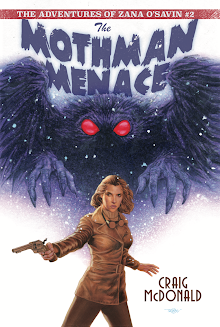
The Adventures of Zana O'Savin continue! Pulp fiction for our time in the spirit of Doc Savage, The Shadow & The Avenger.
THE BLOOD OGRE
Prolific pulp novel legends Lester Dent (Doc Savage) & Walter B. Gibson (The Shadow) both had the actual experience of witnessing their characters come to life, a chilling historical claim that sets the stage for this new series of neo-noir pulp adventures!
WRITE FROM WRONG
Hector Lassiter, Black Mask Magazine legend, crime novelist and screenwriter rubs shoulders with a who's who of 20th Century legends including Ernest Hemingway, Doc Savage creator Lester Dent, Walter B. Gibson of Shadow fame and Orson Wells.
HEAD GAMES, THE GRAPHIC NOVEL
A pulp-noir adaptation of the Edgar Award-nominated novel introducing Black Mask author, crime novelist and screenwriter Hector Lassiter.
Edgar®/Anthony/Macavity/Gumshoe/Crimespree nominated novelist of HEAD GAMES: THE GRAPHIC NOVEL, ONCE A WORLD, WRITE FROM WRONG, ONE TRUE SENTENCE, FOREVER'S JUST PRETEND, TOROS & TORSOS, THE GREAT PRETENDER, ROLL THE CREDITS, THE RUNNING KIND, HEAD GAMES, PRINT THE LEGEND, DEATH IN THE FACE, THREE CHORDS & THE TRUTH, EL GAVILAN, PARTS UNKNOWN, CARNIVAL NOIR, CABAL and ANGELS OF DARKNESS. Nonfiction titles include ART IN THE BLOOD and ROGUE MALES: CONVERSATIONS & CONFRONTATIONS ABOUT THE WRITING LIFE.
ONCE A WORLD — The acclaimed prequel to the Hector Lassiter series
Hector Lassiter's story begins, from his journey into Mexico to catch Pancho Villa, to the bloody trenches of World War I.
ONE TRUE SENTENCE (Hector Lassiter Series #1)
Hector Lassiter Series: #1 Bestseller, Amazon.com.au; One Of BookPeople's Top 10 Of 2011 & Poisoned Pen Staff Favorite. "Vivid, remarkable characters... Absolutely gripping!"—Diana Gabaldon
FOREVER'S JUST PRETEND (HECTOR LASSITER SERIES #2)
Hector Lassiter Series: #3 Bestseller, Amazon.com.au! "Entertaining...a must read for series fans &...for new readers."—Publishers Weekly
TOROS & TORSOS (HECTOR LASSITER SERIES #3)
Hector Lassiter Series: #4 Bestseller, Amazon.com.au! Named to numerous Year's Best Lists! "A bold, ambitious, genre-bending novel."—George Pelecanos
THE GREAT PRETENDER (HECTOR LASSITER SERIES #4)
Hector Lassiter Series: #2 Bestseller, Amazon.com.au! "McDonald cagily splits up the action, with Welles in full enfant terrible mode in the first half of the book—much of the story unfolds on the night of the infamous War of the Worlds broadcast in 1938—while the second takes place in the late 1940s as the filmmaker's star is already burning out."—Vince Keenan, author of DOWN THE HATCH
ROLL THE CREDITS (HECTOR LASSITER SERIES #5)
Hector Lassiter Series: #5 Bestseller, Amazon.com.au! "A writer of truly unique voice, approach, and ambition, Craig McDonald delivers again with ROLL THE CREDITS. Not to be missed." —Michael Koryta
THE RUNNING KIND (HECTOR LASSITER SERIES #6)
"Just the right amount of history, suspense, action and familiar faces to make his alternative history fascinating."—Terry Bowman, author of FIONA'S RULES
HEAD GAMES (HECTOR LASSITER SERIES #7)
Hector Lassiter series: Edgar & Anthony Awards Finalist! #5 Bestseller, Amazon.com.au! Coming autumn 2017 as a graphic novel from First Second! "Smart, it's funny, and it moves like a roach when the lights go on."—James Sallis
PRINT THE LEGEND (HECTOR LASSITER SERIES #8)
Named To More Than A Dozen Year's Best Lists; the most translated of the internationally best-selling series of novels! "An epic masterpiece.”—Michael Connelly.
DEATH IN THE FACE (HECTOR LASSITER SERIES #9)
The penultimate Hector Lassiter novel with 007-creator Ian Fleming; selected by The Rap Sheet as a 2015 novel of the year; praised by Publishers Weekly and Booklist!
THREE CHORDS & THE TRUTH (Hector Lassiter series #10)
The climax of the Hector Lassiter series, from Betimes Books. "With THREE CHORDS & THE TRUTH, Craig McDonald has crafted a remarkable coda to the series."—Steven Powell, author of JAMES ELLROY: DEMON DOG OF CRIME FICTION; "Grabs the reader by the throat." —Publishers Weekly. Get your copy here https://www.amazon.com/dp/B01N0D4UFX
BORDERLAND NOIR
Now Available from Betimes Books
EL GAVILAN
Starred Review From Publishers Weekly! PW Pick of the Week. "As sobering and as urgent as tomorrow's headlines."—Publishers Weekly
PARTS UNKNOWN (CHRIS LYON SERIES #1)
#1 in Chris Lyon series of eBook exclusive thrillers, now available
CARNIVAL NOIR (CHRIS LYON SERIES #2)
#2 in Chris Lyon series of eBook exclusive thrillers, now available.
CABAL (CHRIS LYON SERIES #3)
#3 in Chris Lyon series of eBook exclusive thrillers, now available.
ANGELS OF DARKNESS (CHRIS LYON SERIES #4)
#4 in Chris Lyon series of eBook exclusive thrillers, now available and featuring Hector Lassiter!




 Posts
Posts

