(Note: this is the first in a series of posts examining the strategies, concepts and creative process behind the repackaging of the Hector Lassiter series into uniform editions for Betimes Books). "One True Sentence" is chronologically the first novel in the Hector Lassiter series, and it is set in 1924 Paris. For those not familiar with the series, it revolves around Lassiter, a novelist and screenwriter who increasingly becomes noted for blending his life and art, sometimes to startling or even dangerous effect. The novels are best described as literary historical thrillers and typically feature real historic personages and events, faithfully depicted, often in far flung locations.
"One True Sentence" originally appeared from St. Martin's Minotaur in February 2011. In original publication sequence, it was the fourth Lassiter novel to see the light of day. Its cover and packaging was radically different from the three titles that preceded it, and that embodied a growing concern I had as my Lassiter books went out into the world: Across four linked novels, there were four vastly different branding concepts playing out. Not one of the four books clearly stood out as being linked to another. Someday, I promised myself, I would see the Lassiter series presented in uniform editions, fronted by something much closer to the striking covers I saw in my mind's eye but which became twisted or lost in the process of working with two different publishers, three editors and four different designers.
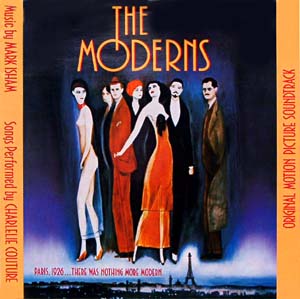
"One True Sentence" was partly inspired by my love of the Alan Rudolph film "The Moderns" which also mixes historical and fictional characters in 1926 Paris, just as Ernest Hemingway is burning down his first marriage and riding the buzz of his first novel, "The Sun Also Rises." OTS was given a painted cover by the sublime Echo Chernik. Echo did a wonderful job of catching a sense of the dreamy, boozy, floating party that was Paris in the early 1920s — at least for the literary and artistic expatriate types stalking the Left Bank in those days. If Ms. Chernik had provided illustrations for the prior three Lassiters, branding-wise, we would have had something pretty wonderful, I think. Look close at her illustration for "One True Sentence," and you'll find lurking behind Hemingway a pensive Gertrude Stein and a brooding Louise Brooks, (the silent screen siren is standing in for Hector's great love, fellow writer Brinke Devlin; Brinke is said to resemble Brooks in many ways). For OTS's French publication, Belfond — which chose to market all of my books with covers featuring photographs of women — went this direction, cropping in close on the face of some 1920s belle:
When the folks at Betimes and I began to discuss branding strategies and cover concepts for the Hector Lassiter series, we knew we wanted to put across location, some of the more recognizable historical figures appearing from book to book, and to give face to Hector Lassiter for the first time. The latter wasn't particularly challenging. It was established very, very early in the series that Hector bears a striking resemblance to actor William Holden—a resemblance so strong, in fact, it becomes a key plot point in "Roll the Credits." In laying out our plan for "One True Sentence,” the all-important cover we knew would be the tone-setter for the nine volumes to follow, we knew we needed Hector, Hemingway (who is Lassiter's sidekick in the novel) and something that telegraphs Paris.
We first arrived at an abstract approximation of the eventual cover. Wanting something more James Bama/neo-realistic, I resisted the impressionistic approach, and we ended up with the final cut, designed by J.T. Lindroos, who will at last be giving the Hector Lassiter series a uniform look across its span.
At this writing, eight of the ten Lassiter volumes coming from Betimes Books have at last found their definitive covers. All that remains are a cover for the climactic novel in the series, "Three Chords & The Truth," and a collection of short stories featuring Hector that we'll be calling, "Write from Wrong." NEXT UP: TOROS & TORSOS
Here’s a blast from the past: I’m pretty sure Vince Keenan, brave and
kind soul that he is, holds the record for interviewing me the most times. This
one first appeared on his site in 2011 when “One True Sentence” debuted in
hardcover. This is a slightly shortened version of that interview. You can also
reads Mr. Keenan’s review of OTS here.—Craig McDonald, October 13, 2014
What can you tell us about “One True Sentence”?
It’s 1920s Paris. It’s stands
as the first Lassiter novel,
chronologically. It’s crime novelist/screenwriter Hector Lassiter at ground
zero. It’s the book in which he finds his writer’s voice, his path as a genre
author, and in which he meets the woman who more or less “invents” the
man/character of Hector Lassiter as we’ve come to know him in the three
previous novels.
How do you feel the Lost Generation of expatriate American artists in
1920s France are viewed today? What fictional works depict that era best?
I think “The Lost
Generation” has become almost a kind of brand that typifies a way of careless
and carnal living as much as the (mostly perishable) writing produced by that
generation.
As to works that catch
that world, in terms of literature, I’d go with Hemingway’s “A Moveable Feast,”
which poses as a memoir, but which Hemingway invites readers to regard as
fiction. I personally take the book as a mixture of fact and fiction — as much
novel as reminiscence.
My favorite film on that
era, and one that has inspired to a degree “One True Sentence” and the earlier
“Toros & Torsos,” is the Alan Rudolph film, “The Moderns.” It’s set in
mid-1920s Paris, as Hemingway is between wives and “The Sun Also Rises” is just
making its mark. It’s a mix of fictional and real characters including
Hemingway and Gertrude Stein and a scathing look at art and the tension between
life and the page (or canvas). It’s dark comedy punctuated with hot sex, a
dreamy flavor of camera work and blurring of times, all set to a terrific,
seductive score by Mark Isham.
You’ve said this book wraps up a loose trilogy within the Hector
Lassiter series about Hec’s friendship with Ernest Hemingway. What effect does
the popular conception of Hemingway have on your treatment of him as a
character? Does his larger-than-life image make it easier or more difficult to
write about him? Conversely, what challenges are posed by writing about
real-life figures who are lesser known to contemporary readers, like Ford Madox
Ford?
I try to write Hemingway
as I think he must have been — warts and all, struggling with what was probably
a fatal bi-polar condition and self-medicating as best he could with writing
and alcohol. I’m frankly astounded he survived into his sixties. I’m not sure
how widely Hem is read these days by those under, say, age 40, and if he is, I
suspect his image as a man is probably shaped by comments by partisan
professors and a few lines of biography at the back of his books.
In the 1980s, particularly
after his last wife died, there were scores of Hemingway biographies published;
a mini-series of his life in which Stacy Keach appeared. That all kind of
tapered off in the late 1990s. I don’t think a major biography of Hemingway has
appeared in the past decade or so. So I think his actual personality and
biography are receding in the collective unconscious again. A piece of trivia:
this summer will in fact mark the 50th anniversary of Hem’s death.
In terms of writing Ford
and Gertrude Stein and the like, I essentially tried to portray them in a
manner consistent with Hemingway’s portraits in “A Moveable Feast,” and,
really, as simply other characters. In that sense, “One True Sentence” was
essentially conceived to be a crime novel recasting of Hemingway’s “Feast.”
A recurring theme in the book is the distinction between literary and
genre writing, and between types within genre (crime fiction versus mystery
fiction). How seriously were such distinctions taken in the salons of 1920s Paris?
What about today?
One of the first books
Gertrude Stein gave an unknown Hemingway to read was the crime novel “The
Lodger,” Marie Belloc Lowndes’ Jack the Ripper novel. Stein regarded it as a
mystery but of a higher level than most. Hem shared her take. Stein really was
an unabashed mystery fan and called her favorite mystery writers “mystifiers.”
Hemingway biographies and letters to his publisher requesting novels to be
shipped to him include books by Ian Fleming, Raymond Chandler and Georges Simenon,
among many others. Hem dug crime fiction, in his way.
The great tension of the
time — then and I guess even now — was the conflict between literary and genre
fiction. Hemingway was a critical darling when he was unpaid and writing for
little magazines and publishing with obscure presses that printed books in runs
of under 200. As soon as he signed with Scribner’s and entered the mainstream,
Hem was vilified by the Left Bank literati. Going from an Indy to a major house
can be a real risk for an author who doesn’t quiet keep a foot comfortably in
either pond, and Hem took it from several nasty directions for making that
change to a mainstream outlet. Paraphrasing, Hem said he aimed to be read by
the low- and the high-brows. And you
know, in the end, he pulled it off.
What authors inspired Hector Lassiter? Are there real-world antecedents
for Hec’s paramour and fellow writer Brinke Devlin?
Hector is a an amalgam of
various writers including James Crumley, Jonathan Latimer (a short-lived
Hemingway friend in Key West) and a couple of others I’m not quite prepared to
identify yet.
And Brinke? Brinke Devlin
is modeled on a real woman, but recast to resemble Louise Brooks and to write a
bit like Craig Rice. Brinke is, in a sense, the female version of Hector and,
as it proves out, a kind of template for Hector’s own writer’s persona. Not to
say she’s his one true love, but she is the
pivotal woman in his life, that simple.
You wrote all eight books in the Lassiter series, of which “One True
Sentence” is the fourth, before the second was published. At what point did you
realize the scale of this project? Has that scale affected the publishing
process?
I wrote the first, “Head
Games,” and figured I was done with Hector. So I wrote a standalone novel
that’s scheduled to appear later this fall (“El Gavilan”). After I finished
that, I got the idea for “Toros & Torsos” and realized it required Hector
as “hero.” From there, I just kept writing them until I knew I had completed
Hector’s arc. The ninth and last novel (“Three Chords & The Truth”) will
bring us something like full circle, finally revealing what ever happened to
Hector Lassiter. A lot of old faces will appear in that one from the first
book. It really is a circle-closer.
The tricky thing is,
because all the books exist, there’s a second-guessing and a re-sequencing that
has happened as a result of editors coming, going and changing their minds. The
first two novels followed my chosen sequence. “Print the Legend,” the
third-published novel, was originally intended to be the next-to last book. OTS
was always meant to be number three. I think we’re firmly back to my original
sequence, now. The novel that should appear after “One True Sentence” (“Forever’s
Just Pretend”) comes right off the end of OTS.
What Hector book will we be seeing next?
In terms of another novel, “Forever’s Just Pretend” is set
across several holidays in 1925 Key West. It’s a love story, centrally; very
character-driven. It’s also a bit of a change from the other books in that no
historical figures appear in the novel. What we get instead is the
deepest, hardest look into Hector Lassiter, the man, we’ve seen. It’s also the
only thing akin to a true sequel across the nine novels.
Movie Question: What’s the best cinematic adaptation of Hemingway’s
work?
That may be impossible to
answer in the sense they all pretty much blow. Nearly every one I’ve seen has
been baaad. “For Whom the Bell Tolls”
has some good moments and a stirring score. But Gary Cooper and Ingrid Bergman
are too old for their roles. On the other hand, that one had the courage to use
a Hemingway downbeat ending which doesn’t happen very often. “Islands in the
Stream” is kind of interesting in that George C. Scott is essentially
portraying Hemingway more than Hem’s character of Thomas Hudson. The first
version of “The Old Man and the Sea” is mostly notable only because Hem and
fourth wife Mary appear in a background scene at one point. “The Killers” is
iconic as a film noir and the only movie based on his own work Hemingway ever
really liked, but it also had to shovel on acres of material to pad out the
short story upon which it is based. I know there’s a version of “Garden of
Eden” looming, but that’s not exactly regarded as a true Hemingway novel since
it was edited to a fraction of its original length by Tom Jenks.
Baseball Question: You live in Central Ohio. Reds or Indians?
Like Hector, I’ve never
been much of a baseball fan. It was the Reds growing up, and I went to a game
or two (Cincy is 100 miles due south of my hometown). As a kid, I sat in the
stands and watched Hank Aaron phone it in at Riverfront Stadium so he could
break the home run record in his next game
in his native state — that further soured my attitude for the game, a bit. The
only televised sport I really ever watched consistently was billiards when
they’d put the old hustlers like Utley Puckett and Luther — ahem — Lassiter up against one another in the 1980s. And that, in fact, is
the man who gave Hector his surname.
Cocktail
Question: You’re in a well-stocked bar. What do you order?
Back in the day, I went through a Glenmorangie craze; some other single
malts. I got married in Scotland and sort of sampled the local fare across the
Highlands for a couple of weeks. Now it would probably just be a potent and
well-made margarita on the rocks, with salt. I’m no beer drinker, and I detest gin. Like Hector, I have an
inexplicable but deep-seated distrust
of gin drinkers.
The Adventures of Zana O'Savin continue! Pulp fiction for our time in the spirit of Doc Savage, The Shadow & The Avenger.
THE BLOOD OGRE
Prolific pulp novel legends Lester Dent (Doc Savage) & Walter B. Gibson (The Shadow) both had the actual experience of witnessing their characters come to life, a chilling historical claim that sets the stage for this new series of neo-noir pulp adventures!
WRITE FROM WRONG
Hector Lassiter, Black Mask Magazine legend, crime novelist and screenwriter rubs shoulders with a who's who of 20th Century legends including Ernest Hemingway, Doc Savage creator Lester Dent, Walter B. Gibson of Shadow fame and Orson Wells.
HEAD GAMES, THE GRAPHIC NOVEL
A pulp-noir adaptation of the Edgar Award-nominated novel introducing Black Mask author, crime novelist and screenwriter Hector Lassiter.
Edgar®/Anthony/Macavity/Gumshoe/Crimespree nominated novelist of HEAD GAMES: THE GRAPHIC NOVEL, ONCE A WORLD, WRITE FROM WRONG, ONE TRUE SENTENCE, FOREVER'S JUST PRETEND, TOROS & TORSOS, THE GREAT PRETENDER, ROLL THE CREDITS, THE RUNNING KIND, HEAD GAMES, PRINT THE LEGEND, DEATH IN THE FACE, THREE CHORDS & THE TRUTH, EL GAVILAN, PARTS UNKNOWN, CARNIVAL NOIR, CABAL and ANGELS OF DARKNESS. Nonfiction titles include ART IN THE BLOOD and ROGUE MALES: CONVERSATIONS & CONFRONTATIONS ABOUT THE WRITING LIFE.
ONCE A WORLD — The acclaimed prequel to the Hector Lassiter series
Hector Lassiter's story begins, from his journey into Mexico to catch Pancho Villa, to the bloody trenches of World War I.
ONE TRUE SENTENCE (Hector Lassiter Series #1)
Hector Lassiter Series: #1 Bestseller, Amazon.com.au; One Of BookPeople's Top 10 Of 2011 & Poisoned Pen Staff Favorite. "Vivid, remarkable characters... Absolutely gripping!"—Diana Gabaldon
FOREVER'S JUST PRETEND (HECTOR LASSITER SERIES #2)
Hector Lassiter Series: #3 Bestseller, Amazon.com.au! "Entertaining...a must read for series fans &...for new readers."—Publishers Weekly
TOROS & TORSOS (HECTOR LASSITER SERIES #3)
Hector Lassiter Series: #4 Bestseller, Amazon.com.au! Named to numerous Year's Best Lists! "A bold, ambitious, genre-bending novel."—George Pelecanos
THE GREAT PRETENDER (HECTOR LASSITER SERIES #4)
Hector Lassiter Series: #2 Bestseller, Amazon.com.au! "McDonald cagily splits up the action, with Welles in full enfant terrible mode in the first half of the book—much of the story unfolds on the night of the infamous War of the Worlds broadcast in 1938—while the second takes place in the late 1940s as the filmmaker's star is already burning out."—Vince Keenan, author of DOWN THE HATCH
ROLL THE CREDITS (HECTOR LASSITER SERIES #5)
Hector Lassiter Series: #5 Bestseller, Amazon.com.au! "A writer of truly unique voice, approach, and ambition, Craig McDonald delivers again with ROLL THE CREDITS. Not to be missed." —Michael Koryta
THE RUNNING KIND (HECTOR LASSITER SERIES #6)
"Just the right amount of history, suspense, action and familiar faces to make his alternative history fascinating."—Terry Bowman, author of FIONA'S RULES
HEAD GAMES (HECTOR LASSITER SERIES #7)
Hector Lassiter series: Edgar & Anthony Awards Finalist! #5 Bestseller, Amazon.com.au! Coming autumn 2017 as a graphic novel from First Second! "Smart, it's funny, and it moves like a roach when the lights go on."—James Sallis
PRINT THE LEGEND (HECTOR LASSITER SERIES #8)
Named To More Than A Dozen Year's Best Lists; the most translated of the internationally best-selling series of novels! "An epic masterpiece.”—Michael Connelly.
DEATH IN THE FACE (HECTOR LASSITER SERIES #9)
The penultimate Hector Lassiter novel with 007-creator Ian Fleming; selected by The Rap Sheet as a 2015 novel of the year; praised by Publishers Weekly and Booklist!
THREE CHORDS & THE TRUTH (Hector Lassiter series #10)
The climax of the Hector Lassiter series, from Betimes Books. "With THREE CHORDS & THE TRUTH, Craig McDonald has crafted a remarkable coda to the series."—Steven Powell, author of JAMES ELLROY: DEMON DOG OF CRIME FICTION; "Grabs the reader by the throat." —Publishers Weekly. Get your copy here https://www.amazon.com/dp/B01N0D4UFX
BORDERLAND NOIR
Now Available from Betimes Books
EL GAVILAN
Starred Review From Publishers Weekly! PW Pick of the Week. "As sobering and as urgent as tomorrow's headlines."—Publishers Weekly
PARTS UNKNOWN (CHRIS LYON SERIES #1)
#1 in Chris Lyon series of eBook exclusive thrillers, now available
CARNIVAL NOIR (CHRIS LYON SERIES #2)
#2 in Chris Lyon series of eBook exclusive thrillers, now available.
CABAL (CHRIS LYON SERIES #3)
#3 in Chris Lyon series of eBook exclusive thrillers, now available.
ANGELS OF DARKNESS (CHRIS LYON SERIES #4)
#4 in Chris Lyon series of eBook exclusive thrillers, now available and featuring Hector Lassiter!


 OTS was given a painted cover by the sublime Echo Chernik. Echo did a wonderful job of catching a sense of the dreamy, boozy, floating party that was Paris in the early 1920s — at least for the literary and artistic expatriate types stalking the Left Bank in those days. If Ms. Chernik had provided illustrations for the prior three Lassiters, branding-wise, we would have had something pretty wonderful, I think.
 Look close at her illustration for "One True Sentence," and you'll find lurking behind Hemingway a pensive Gertrude Stein and a brooding Louise Brooks, (the silent screen siren is standing in for Hector's great love, fellow writer Brinke Devlin; Brinke is said to resemble Brooks in many ways).




 Posts
Posts

